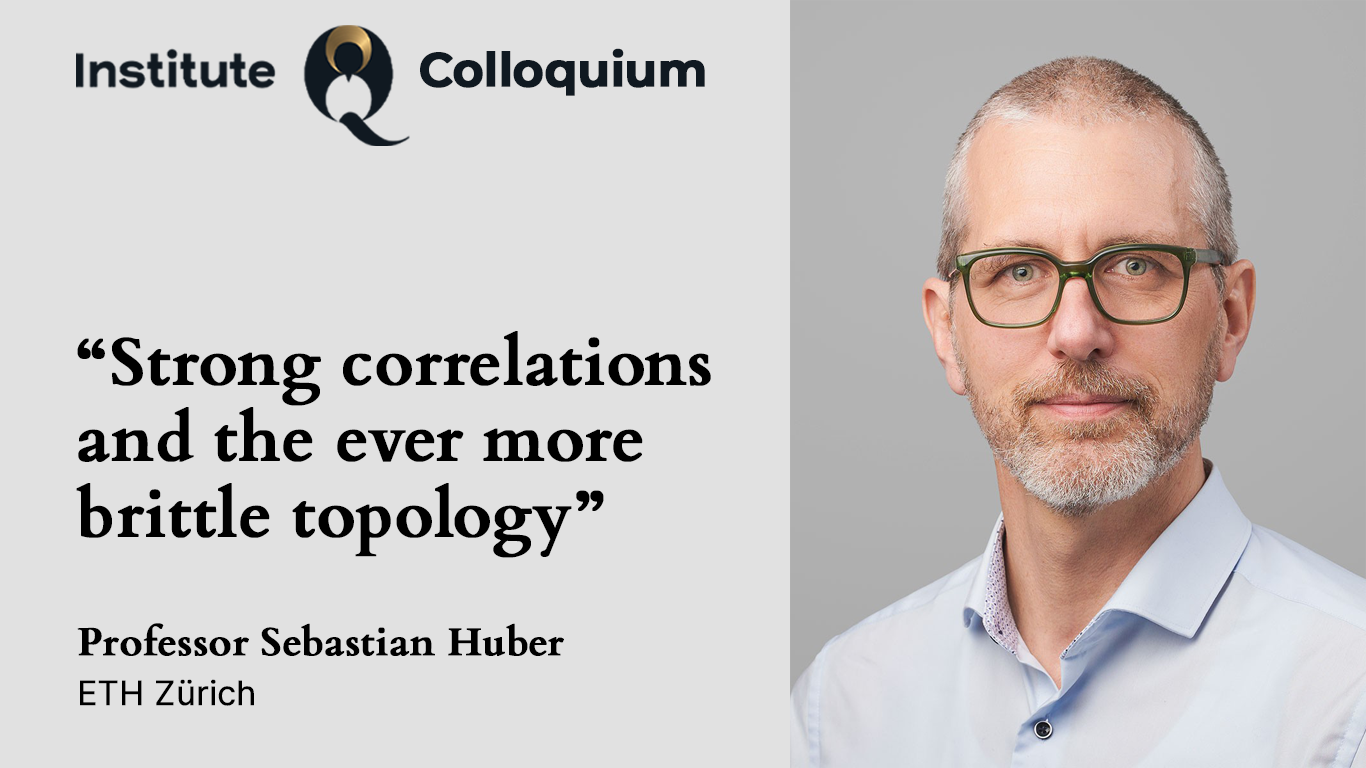
This InstituteQ Colloquium features Professor Sebastian Huber from ETH Zürich. The title of his talk is “Strong correlations and the ever more brittle topology.”
Sebastian Huber studied physics at ETH Zürich, where he received his diploma in 2004. Following his doctoral studies under the supervision of Prof. Gianni Blatter, he moved to the Weizmann Institute of Science in Rehovot, Israel. His work there was supported by fellowships from the Swiss Friends of the Weizmann Institute, the Koshland Prize, and the Swiss National Science Foundation (SNSF).
In 2012, he returned to the Institute for Theoretical Physics at ETH Zürich as an SNSF Professor. Since 2018, he has led his research group within the framework of an ERC Consolidator Grant, and in 2020 he took on the role of Managing Director of the Department of Physics (D PHYS).
Sebastian Huber’s research focuses on quantum many-body systems and the exploration of topological and non-equilibrium phenomena across a range of physical platforms. His group combines theoretical work with close links to experiments and has contributed to a number of high-profile results, including advances in topological mechanics, mechanical metamaterials, and the use of information-theoretic and machine-learning methods in quantum physics. These efforts have helped establish new approaches to designing and understanding emergent behavior in complex systems.
Event details:
When: 14:00-15:00 on 20.8.2026
Where: Lecture Hall V001, Ekonominaukio 1, Aalto University & online
Host: Aalto University Professor Päivi Törmä
From Sebastian Huber: What will your talk discuss?
Flat bands promise strong superconductivity by quenching kinetic energy, yet their ability to host pairing is governed by quantum geometry. Over time, a richer story has emerged: from robust to fragile and increasingly delicate forms of topology, ever more subtle band structures reveal unexpected superconducting behavior. These insights link engineered platforms with electronic materials, culminating in recent experiments that directly probe the intriguing multi-band nature of modern topology.