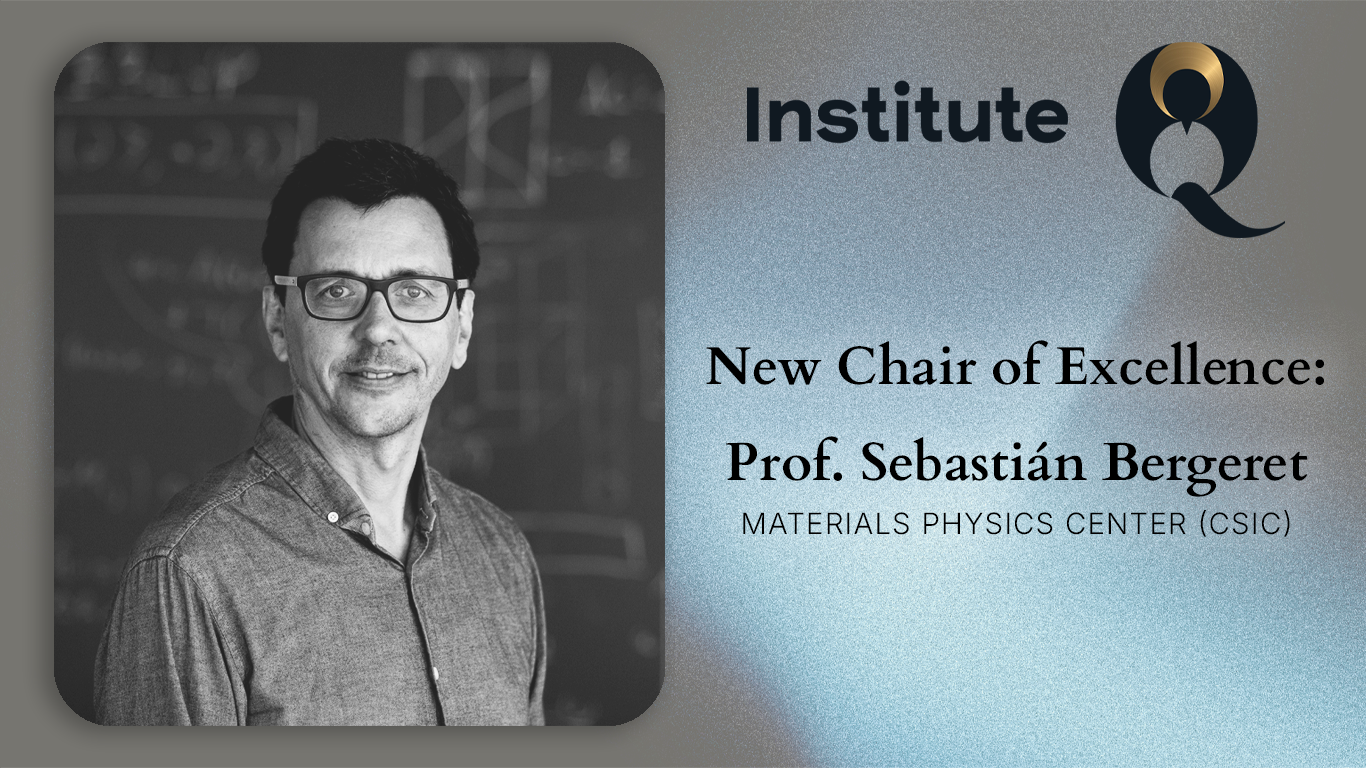
CSIC Research Professor Sebastián Bergeret has been selected as the new InstituteQ Chair of Excellence for the 2026-2028 term, hosted at the University of Jyväskylä.
This Chair of Excellence position was awarded as part of InstituteQ’s third Chair of Excellence call. This program is designed to host international leading experts and eminent scholars at one of the host organizations at InstituteQ for a three-year term. Previous Chairs include Professor Serget Kubatkin (2024 call) and Professors Charles Marcus and Simon Devitt (2023 call).
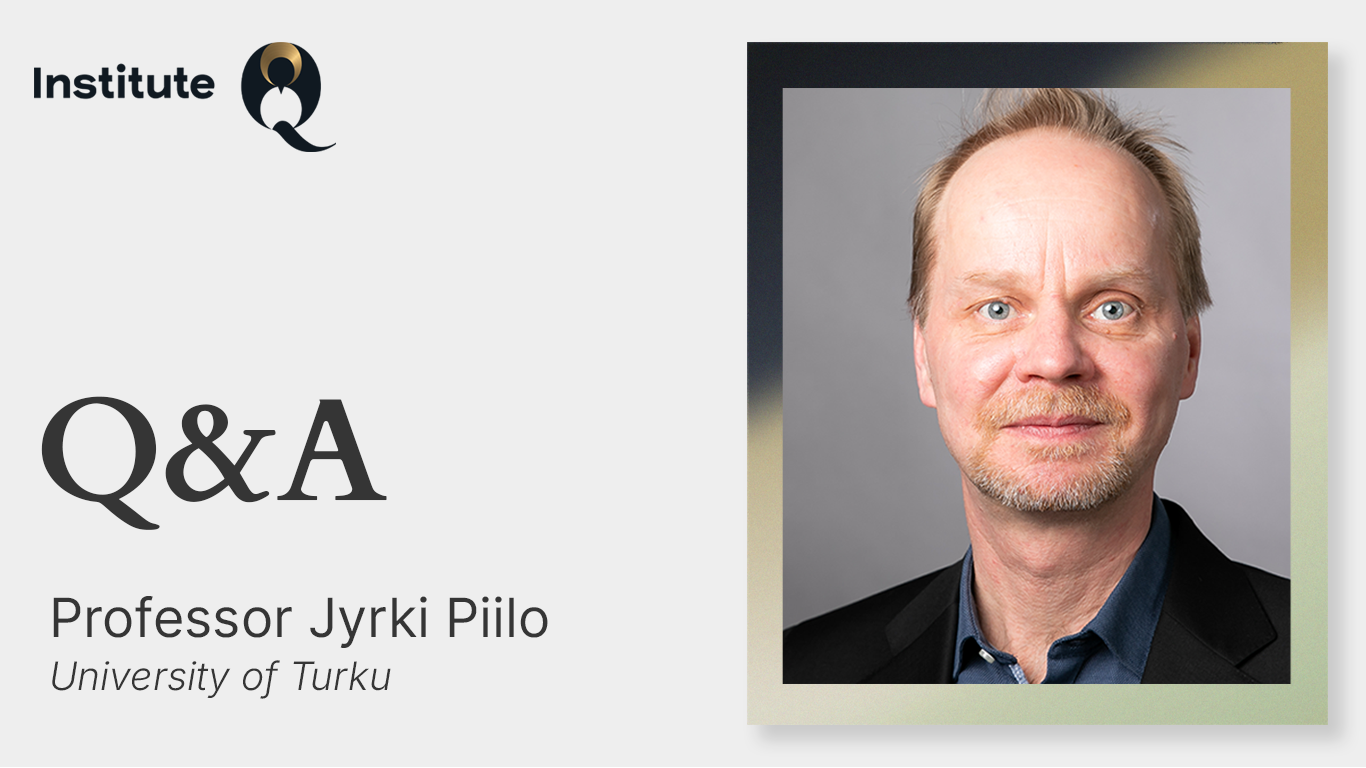
Sebastián Bergeret leads the Mesoscopic Physics Group at the Materials Physics Center in San Sebastián, Spain. Read his Q&A interview regarding his plans for his Chair of Excellence position below:
What are you and your group’s particular areas of specialty in quantum science and technology?
Our research group works broadly in the field of theoretical condensed matter physics. More specifically, we focus on various aspects of quantum transport, with a particular emphasis on superconductivity, magnetism, and their interplay.
Our activities span the different length scales that are relevant to modern quantum experiments and technologies. At the microscopic level, we investigate phenomena that are crucial for techniques such as scanning tunneling microscopy. At the mesoscopic scale, we study the properties of real devices used in emerging technologies, including superconducting qubits and other superconducting electronic devices.
Our research aims to predict, explain, and support experimental observations by analyzing how quantum effects manifest themselves in transport properties. In this way, we contribute to a deeper understanding of quantum materials and devices and help bridge the gap between fundamental theory and experimental realization.
How did you first get introduced to Professor Tero Heikkilä and his research group at the University of Jyväskylä?
I first met Professor Tero Heikkilä at a workshop in Germany during the early stages of our careers. At that time, I was working on what later became an important theoretical prediction: the generation of equal-spin Cooper pairs in ferromagnets through the superconducting proximity effect. Tero was also interested in related physics and working on interesting non-equilibrium effects in superconducting hybrids.
Although we were not in close contact for several years, we renewed our scientific interactions in 2009, after both of us had established independent research groups, initiating a long-term collaboration between our teams. Since then, we have worked together on a variety of topics. Our collaboration has resulted in numerous scientific publications, joint patents, and participation in a European project coordinated by Tero on superconducting bolometers.
An important aspect of this collaboration has been the continuous exchange of students and postdoctoral researchers between our groups, promoting the transfer of knowledge, expertise, and new ideas. Over the years, this collaboration has grown into a highly productive and long-lasting scientific partnership that continues to generate new research directions and opportunities.
The Chair of Excellence grant now provides a unique opportunity to take this synergy to a new level, strengthening the integration of our research activities, expanding scientific exchanges, and enabling us to tackle more ambitious and interdisciplinary challenges together.
How do you see the quantum research ecosystems of Finland and Spain complementing each other? What are some important distinctions?
Let me answer from the perspective of the Basque Country, where my institution, the Materials Physics Center, is based. The Basque Country has a rich tradition in theoretical condensed matter physics. In addition, government agencies and regional institutions, such as the Materials Physics Center and the Donostia International Physics Center, are strongly committed to fostering quantum technology ecosystems, which are currently gaining significant momentum. Much of the this momentum has been driven by quantum computing initiatives, particularly following the acquisition of an IBM quantum computer. At the same time, important efforts are underway in areas such as superconducting circuits, spin qubits, quantum sensing, and quantum optics.
As we know, quantum technologies require particularly close coordination between fundamental research, engineering, startups and spin-offs, and established industrial partners. Perhaps more than in many other technological fields, progress depends on the efficient transfer of knowledge across the entire innovation chain, from basic scientific discoveries to technological implementation and commercialization. Building and maintaining such an ecosystem takes time and requires strong interactions among all stakeholders.
Finland, on the other hand, has a longer track record in translating scientific research into technological innovation, as well as a more established tradition in quantum technologies. From what I have observed, the Finnish ecosystem is characterized by a particularly strong integration of education, fundamental research, engineering expertise, innovation, and technological development. In this context, InstituteQ is playing a particularly important role, serving as an excellent example of how these different components can be connected within a coherent quantum ecosystem. The Basque Country has recently taken important steps in the same direction through initiatives such as BasQ.
For this reason, I see significant opportunities for collaboration between Finland and the Basque Country. Programs such as the InstituteQ visitor grants are essential for strengthening cooperation among European institutions working in quantum technologies and fostering the exchange of scientists, students, expertise, and ideas. At a time of rapid geopolitical change, Europe must combine its strengths to remain at the forefront of emerging technologies. Collaborations of this kind can contribute not only to the development of stronger regional ecosystems, but also to a more competitive and interconnected European quantum technology landscape.
If you could pick one key accomplishment you hope to achieve during the 2026–2028 Chair of Excellence term, what would that be and why?
One key accomplishment I hope to achieve during the Chair of Excellence term is to establish lasting and productive collaborations between my group and several InstituteQ research teams, particularly through the exchange of students, postdoctoral researchers, and scientific visits.
I believe that these personal and scientific connections are often the most effective way to build long-term collaborations. By bringing together researchers from Finland, Spain, and the Basque Country, we can create new synergies that extend beyond individual projects and contribute to stronger ties between our quantum research communities.
From a scientific perspective, there are several concrete research projects that we plan to pursue jointly with Tero Heikkilä’s group, involving experimental collaborators from both countries. These projects focus on quantum transport phenomena, superconducting systems, and quantum materials.
If I had to identify a single key accomplishment, it would be to serve as a catalyst for a new generation of collaborative research, one where the human connections are the scientific accomplishment, not merely a means to it. Enabling our students and postdoctoral researchers to develop innovative ideas and forge long-lasting scientific ties would create an impact that extends beyond the duration of the Chair of Excellence itself.