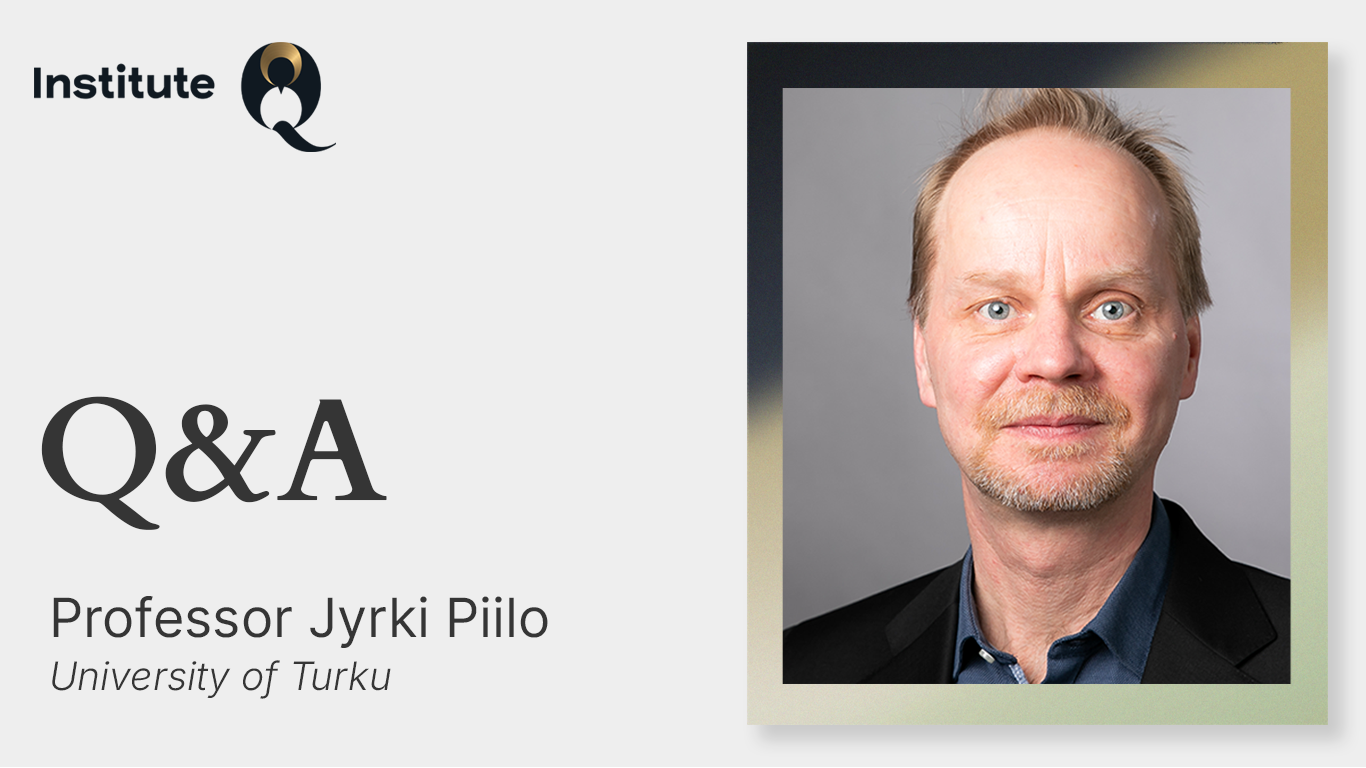
Continuing the InstituteQ Q&A series, we next turn to the University of Turku with Professor Jyrki Piilo. In this interview, Jyrki discusses the University of Turku’s work spanning both theoretical and experimental quantum physics. Recent research highlights include work on protecting quantum teleportation from noise and exploring the role of memory effects in quantum systems.
The discussion also looks ahead to the future of quantum education and research, including the University of Turku’s role in the Quantum Doctoral Pilot Programme (QDOC), as well as its participation in the new QuantNet cross-institutional studies initiative.
What are the University of Turku’s areas of expertise in quantum science and technology?
We have a diverse set of expertise covering both experimental and theoretical quantum science. There is a long tradition of experimental studies of ultra-cold gases of atomic hydrogen and their quantum properties at ultra-low energies. This is also closely associated to work on Bose-Einstein condensates and quantum optics. We also have expertise in room temperature Bose-Einstein condensates and quantum photonics in an experimental group whose studies include quantum physics in optoelectronic devices, too. In the last years, we have also worked on quantum machine learning and complex quantum networks. Another notable area, for a long time, is fundamental research on open quantum systems, understanding loss of quantum properties and their protection from noise.
What are some recent highlights of the University of Turku’s work that you wish to lift up to the InstituteQ community?
In terms of research, we quite recently showed how to protect teleportation – one of the most common quantum protocols – from noise. Also, within the open quantum system framework, we discovered that non-Markovian memory effects appear differently when considering Schrödinger and Heisenberg picture evolution of a quantum system. This was surprising since the two pictures have been previously thought of being essentially equivalent descriptions. Therefore, we currently investigate what this implies for quantum information and whether this could be exploited in quantum protocols.
It is also worth mentioning a very recent result by Luminous Materials and Devices Group, which developed solution-processed organic microcavity laser in the strong light-matter coupling regime. Going beyond quantum information and technologies, while remaining within the scope of fundamental quantum science, recent highlights also include an ERC Consolidator Grant awarded to Risto Paatelainen for the project on first-principles quantum field theory calculations of strongly interacting matter under extreme conditions of temperature and density. While this is currently and dominantly theoretical particle physics, in recent years there has been a number of indications for the possibility to use and combine general open quantum system theory to treat some particle physics problems.
The University of Turku is part of the national Quantum Doctoral Education Pilot Programme (QDOC). How do you see the demands of training Finland’s future quantum workforce changing over the coming years?
This is obviously very interesting and important question. There exists projections indicating very significant increase in terms of numbers. As far as I see it, QDOC has been an excellent early-stage response for this. I am happy that we have a chance to participate to QDOC while, in general, the three-year timeline puts some pressure both on the students and supervisors – considering also that each project has its own characteristics and scientific requirements.
What are some global trends of the field that you are paying special attention to?
Taking rather general perspective, it is indeed very impressive how quantum technologies have progressed in the last years. The same applies for the developments of AI and in its availability. Considering this simultaneous progress in these two areas, it indicates rather exceptional point or period of time we experience at the moment. At least for me, it is difficult to foresee where all this leads to also considering a long-term perspective, say about 20 years time-frame, which is still short time from historical point of view. A relevant aspect here is also how AI could boost quantum research as such, and vice versa, how quantum science could influence AI.
How does the University of Turku work with other universities and research institutes to support quantum education and workforce development?
Within InstituteQ’s EduQ Pillar, we are active in developing a joint study programme in universities related to quantum science (QuantNet) – in a sense that relevant courses provided by a given university would available for the students of other participating universities as well. Indeed, cross-study agreements between universities were signed earlier this summer. This was a non-trivial process, where it is also worth thanking the student affairs offices in different universities. The first courses – available to students this autumn – are provided by University of Helsinki on quantum information and open quantum systems. We hope to expand the course set and selection soon within EduQ. It will be very interesting to see how students react to this and how the scheme progresses and develops in the future.
Quantum science and technology – particularly quantum computing – are getting a lot of hype in the media. What are some of the other applications of quantum technologies that you would like to raise awareness about?
Indeed, quantum science and technology are getting large amount of attention in media including both scientific and commercial aspects. I can see the influence of this also when discussing with students. Considering quantum computation and computers, there exists a number of different physical platforms they are based on. It will be interesting to see, in long-term, which one – or ones – of these turn out to be the most beneficial generally, or whether each one finds its own use area of excellence. Beyond technology, I would still like to emphasize the importance of fundamental and basic research, which underlie technological progress, and the continuing need to fund these, as well.