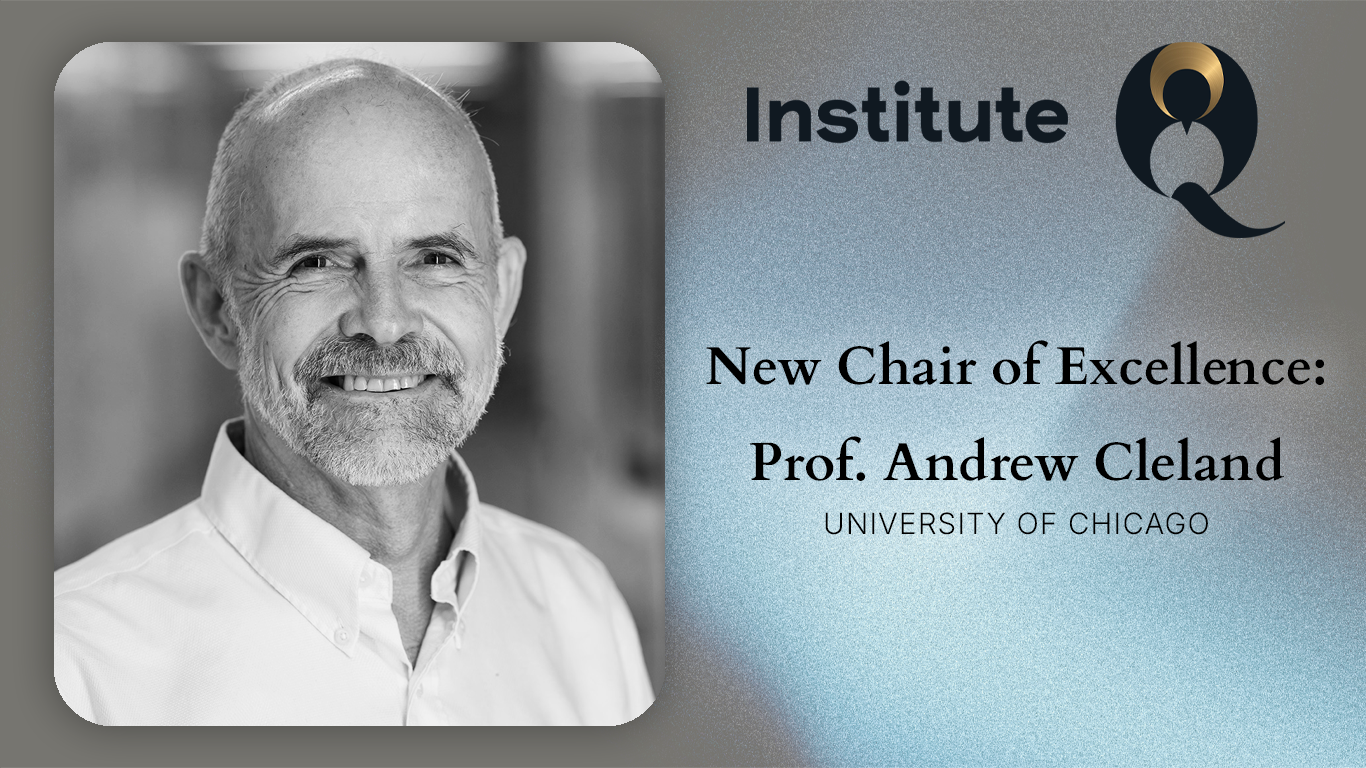
University of Chicago Professor Andrew Cleland has been selected as an InstituteQ Chair of Excellence, hosted at Aalto University.
The InstituteQ Chair of Excellence program is designed to host international leading experts and eminent scholars at one of the host organizations at InstituteQ for a three-year term. Previous Chairs include Professor Serget Kubatkin (2024 call) and Professors Charles Marcus and Simon Devitt (2023 call). CSIC Research Professor Sebastián Bergeret was also selected as part of the 2026-2028 call.
Andrew Cleland is a Fellow of the American Association for the Advancement of Science, and a Fellow of the American Physical Society. He was awarded the Olli V. Lounasmaa Memorial Prize in 2025, was selected as a Vannevar Bush Faculty Fellow in 2024 and as a 2022 Fulbright Distinguished Chair, a 2017-18 Sigma Xi Distinguished Lecturer, and a 2017 APS Kavli Lecturer. His work was recognized as the Science “Breakthrough of the Year” for 2010, and selected as one of the “Top Ten Discoveries in Physics” by the Institute of Physics (United Kingdom) in both 2010 and 2011.
Cleland received his bachelor’s degree in engineering physics in 1983, and his PhD in physics in 1991, both from the University of California, Berkeley. He then pursued research in superconducting systems at the Centre d’Etudes-Orme des Merisiers in Saclay, France, and nanomechanics later at the California Institute of Technology, before joining the faculty of the physics department at the University of California, Santa Barbara in 1997. Prof. Cleland joined the faculty of the University of Chicago in 2014.
Read the Q&A interview regarding his research interests and plans for his time as Chair of Excellence below:
What are you and your group’s particular areas of specialty in quantum science and technology?
My group currently focuses on two areas of research: Superconducting quantum computer architectures and quantum acoustics, where the latter includes experiments on individual phonons (the quanta of sound) where we explore the use of phonons for quantum information applications as well as for quantum sensing.
You have ongoing collaboration with Aalto University groups, including with InstituteQ’s Director, Professor Jukka Pekola. You were also awarded the Olli V. Lounasmaa Memorial Prize in 2025. When did you first get introduced to the Finnish quantum research environment, and how has that relationship evolved?
I have had a long relationship with the Finnish quantum community, where I believe my first visit for professional reasons was to give a series of summer school lectures at Jyvaskyla in 2004, and the first visit I recall to Aalto was in 2012, when I gave a colloquium. Since then, I have visited Aalto or attended conferences and workshops every couple of years or so, with also visits to VTT, OtaNano and Micronova. Please note that I have known Prof. Pekola for much longer than this, having overlapped at Berkeley when he was a postdoctoral researcher and I was a graduate student, in different research groups but on the same floor of one of the Berkeley physics buildings. The Chair of Excellence will allow me to deepen and strengthen the ties I have with many of the faculty at InstituteQ, Aalto, and elsewhere in Finland.
How do the quantum research ecosystems of Finland and United States complement each other? What are some important distinctions?
Although Finland’s quantum ecosystem is naturally smaller than that in the US in terms of number of people, its quantum community has had an outsized impact. In particular, Finland has made significant contributions in an area I am familiar with, superconducting devices, backed by a rich academic history at Aalto University, the University of Helsinki, IQM and VTT, as well as in cryogenics, with BlueFors, a leading hardware resource for quantum labs world-wide.
If you could pick one key accomplishment you hope to achieve during your Chair of Excellence term, what would that be and why?
I would very much like to successfully launch and possibly complete one or two collaborative efforts with researchers in Aalto, as well as establish more links with the younger researchers and students at Aalto and the broader quantum community in Finland, tapping into the very rich and dynamic physics and quantum information communities.
How do you see the role of collaborative organizations like InstituteQ in developing advancements in the field of quantum science and technology?
The global effort in quantum information is heavily focused on developing quantum computing, communication, and software, a landscape in which InstituteQ and the broader Finnish quantum ecosystem play leading roles. As the field matures, new domains with significant commercial and societal impact will inevitably emerge. With its broad research scope and multidisciplinary community, InstituteQ is well-positioned to drive and play a central role in this next phase of evolution.
Quantum science and technology have been receiving a lot of attention in the media lately. What are some developments of the field you are paying close attention to?
Public media coverage of quantum computing continues to suffer from widespread oversimplification, which is a well-known challenge when communicating complex science and engineering to the general public. Media reports frequently gloss over the substantial scientific and engineering challenges that remain before practical quantum computing becomes a reality.
Nevertheless, recent breakthroughs in both quantum hardware and software promise to significantly reduce this gap. Furthermore, emerging innovations may soon transform difficult domains like optimization, an area of very significant interest to the broad business community, but which the media often portrays as already solved. Furthermore, from a philosophical perspective, further developments in this area may help illuminate the still-mysterious boundary between the classical and quantum descriptions of reality.