From Fundamental Theory to National Impact: JYU’s Expanding Role in Finland’s Quantum Ecosystem
The national Quantum Technology Strategy has set ambitious targets for Finland’s efforts to secure its status as a key player in the global field over the coming decade.
InstituteQ plays a central role in the execution of this strategy – one major early activity being the integration of all major quantum science and technology research institutions in Finland under the InstituteQ umbrella.
This expansion culminated in an August 2025 signing agreement between leaders from these institutions. We’re now sitting down with researchers from each of the InstituteQ member organizations to discuss their areas of speciality, ongoing projects and plans for the future.
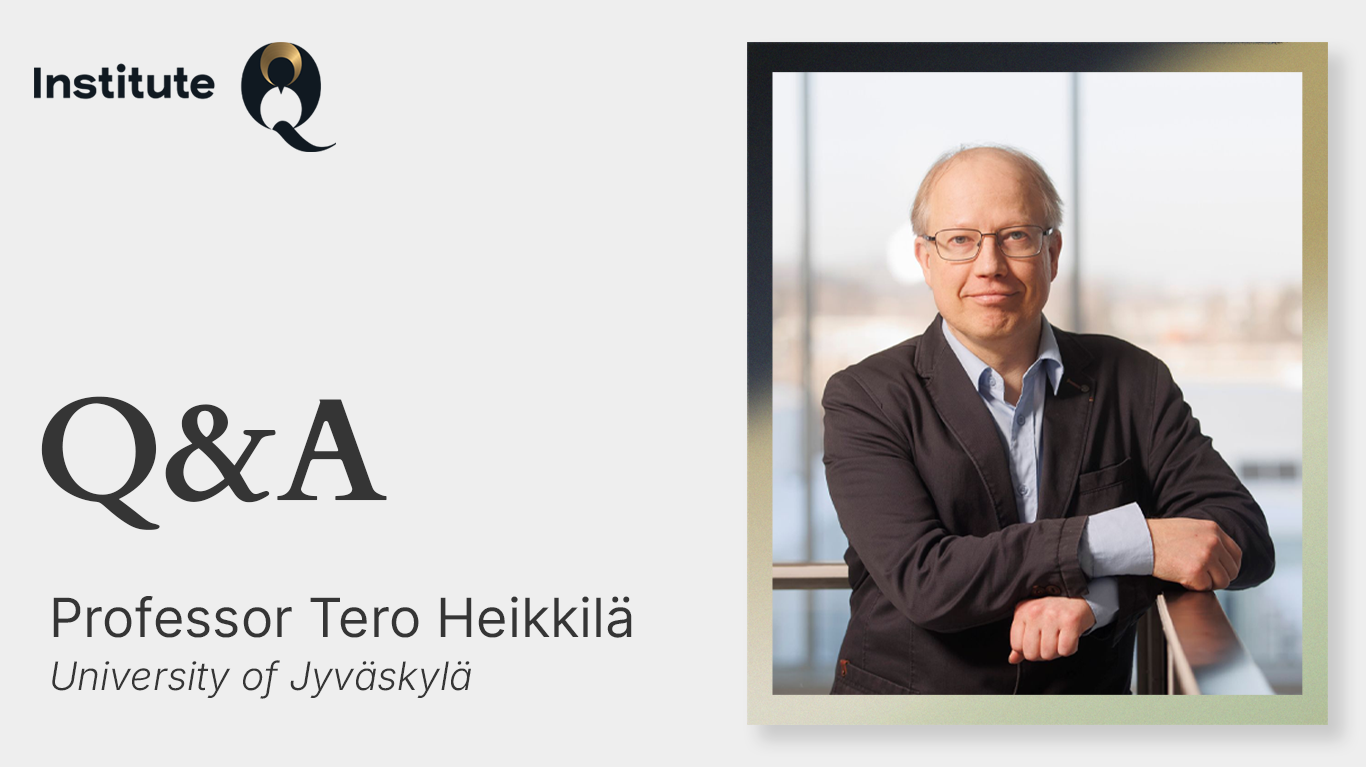
Our first interview is with Professor Tero Heikkilä, who leads the Condensed Matter Theory group at the University of Jyväskylä. Tero sits on InstituteQ’s Steering Group and is part of the Quantum Materials programme of the Finnish Quantum Flagship. Tero also leads the programme committee for the Finnish Quantum Days 2026, taking place from September 9-10 at the University of Jyväskylä.
Additionally, Tero leads the Centre of Excellence in Quantum Materials (QMAT), which will run from 2026-2033. QMAT builds on the strong foundations in Finland on research in quantum physics and technology, low-temperature physics, nanoscience and photonics, laid by decades of commitment into basic research in these fields. Both the Finnish Quantum Flagship and the Centre of Excellence in Quantum Materials are projects funded by the Research Council of Finland.
Finnish Quantum Days 2026
Hosted at the University of Jyväskylä
September 9-10, 2026
For the first time, the Finnish Quantum Days will be hosted by the University of Jyväskylä at their main building.
What are JYU’s areas of expertise in quantum science and technology?
We have expertise in all relevant fields of quantum science and technology: quantum materials, sensors and other devices, computing, simulation and market oversight. Particular focus areas of interest are the correlated electronic states and their properties in two-dimensional materials, silicon-based quantum technologies, hybrid classical-quantum computing methods and algorithms and the societal impact analysis of quantum technologies.
What are some upcoming research themes of the field that you and your team are focused on?
My condensed-matter theory group focuses now in particular on studying superconducting systems in exotic conditions, such as in systems with flat bands or strong spin-orbit coupling, where we both develop the general formal theory and apply it in cases relevant for experiments. We are also interested in new types of superconducting devices, such as microwave circulators or diodes. One interesting new research theme is also studying how quantum systems operate under different types of feedback. In the brand new Centre of Excellence in Quantum Materials, we will study how strong correlations and topology affect the behaviour of hybrid two-dimensional van der Waals materials.
How has JYU’s role in Finland’s quantum ecosystem evolved over the past few years, and where do you see it heading next?
In Jyväskylä there has been recently a lot of investment into forming a wider, local quantum community beyond the members of the major national funding schemes such as the Finnish Quantum Flagship, where we have 7 group leaders, and the Centre of Excellence in Quantum Materials, which we lead and have two participating groups. Quantum simulation and measurements was one of the three university-wide profiling areas in the Profi8 program and led to a recruitment of three tenure track professors and several staff scientists.
Our local survey reached even 27 professors or lecturers with activities within the domain of quantum technologies from three faculties: the Faculty of Mathematics and Science, the Faculty of Information Technology, and the Jyväskylä University School of Business and Economics. We believe this activity will become increasingly visible in Finland’s quantum ecosystem in the next few years especially in research and education, and hopefully in the near term in the innovation and business sector.
What are some recent highlights of JYU’s work that you wish to lift up to the InstituteQ community?
The first one is naturally the new Centre of Excellence QMAT that I lead, and where we want to understand better what type of quantum electronic phases one can find in materials, and how we can exploit them for future technology. Besides my theory group, the other JYU participant is the group of Associate Professor Shawulienu Kezilebieke, whose group prepares and studies different types of hybrid two-dimensional materials with their unique scanning tunneling microscopy setup combining the traditional scanning tunneling microscopy and spectroscopy with optical (laser) driving and detection. Of course, we look forward to the collaboration within the whole QMAT containing 8 groups, besides JYU, also from Aalto, VTT and Tampere.
Another highlight I wish to mention is the first Finnish MOOC course ABC of quantum computing (both in Finnish and English), developed by Prof. Teiko Heinosaari‘s team. Its different parts A, B and C, have different-level target groups, educating them about quantum computing.
I should also mention the local push for silicon quantum technologies led by Prof. Juha Muhonen. This includes the EIC Pathfinder project EQUSPACE led by Juha, and the JYU participation in the European Union’s Chips JU semiconducting qubit pilot line project.
What do you see as Finland’s greatest strengths, or biggest opportunities, in the global quantum landscape?
The greatest strength is definitely the ambitious, tightly knit but large enough quantum community, which of course has friendly internal competition, but ultimately operates on a very collegial basis. I believe that the inclusive approach of InstituteQ is the correct way to grow this community and maximize its impact also on global scale.
I like the way how each of the three pillars – education, research and innovation – receive a lot of attention and together they provide a firm basis for these activities. Recently we have seen a lot of new quantum startups especially around quantum computing, but I believe there is still a lot of room for more industrial activity related with individual quantum hardware components and expertise around them. Naturally the supply chain for this technology does not need to be national, but it helps if we have locally wide expertise about many facets of quantum technology, and especially basic research that not only utilizes but also develops understanding of where that technology can go next.
For me as a theoretical physicist it gives pleasure to see how focusing on fundamental questions of nature in research can lead to original ideas for technology, if we just allow ourselves to include this angle as one of the ways to approach the research topic.
How do you see the role of JYU in Finland’s Quantum Technology Strategy 2025-2035?
JYU’s traditional strength of providing quality education based on strong fundamental research will be instrumental in fulfilling the strategy particularly via educating the workforce needed in quantum technologies. It complements the activities in other InstituteQ member institutes, but I believe that we can make many unique contributions which will turn out highly significant by the year 2035. Besides bringing the strong traditions in education, for example via the MOOC courses, JYU has shown to be the best place in Finland for fostering young researchers with original ideas. This is evidenced by the many ERC projects recently awarded to our young researchers.
JYU is a member of InstituteQ. How can national initiatives like InstituteQ help Finland stay at the forefront of the quantum tech development?
InstituteQ is a great initiative as it shows that ultimately the Finnish quantum community is one community not tied to the institutional boundaries. In quantum technologies, we have already many large consortium projects including many InstituteQ member institutes, such as the Finnish Quantum Flagship, the QMAT Centre of Excellence, and the Quantum Science and Technology doctoral pilot QDOC.
As the individual university efforts into quantum technologies are often smaller than in larger universities elsewhere, uniting forces via InstituteQ helps overcome the critical mass and at the same time allows for fostering diversity in our explorations of quantum technologies. It is already also clear that InstituteQ provides a national contact point that is easy to access from outside, whether it is a company in search of partners in quantum technologies, decision makers in search of information, a young researcher looking for good groups to do research, or a student looking for places where to learn more on this exciting topic. This visibility helps in getting more investments, in improving the quality of our research activities, and in raising awareness of the need for future workforce. These are all essential for staying at the forefront.
How does JYU work with other universities and research institutes to support quantum education and workforce development?
Our researchers are active and in many ways leading members of the EduQ pillar. It links well with the JYU-led FYSNET initiative, whose aim is to create collaboration among the Finnish universities in organizing advanced-level physics courses; as EduQ and FYSNET participants are largely the same, this advances both.
As JYU also educates many of the future high-school physics teachers, we will increasingly include quantum technologies into their education, because we believe they can provide examples for students to understand the link between fundamental research and future technology and thereby raise interest for STEM disciplines. This is a theme we will discuss during the forthcoming Finnish Quantum Days in September in Jyväskylä.
What are you particularly looking forward to in this year’s Finnish Quantum Days programme?
I think the nicest thing about the Quantum Days is to meet colleagues from around Finland. Naturally we will also have an amazing program with a panel on quantum strategy, talks from around the quantum ecosystem, highly interesting scientific talks on quantum materials, devices and information, and a keynote by the Nobel laureate John Martinis. Not to forget some special program for PhD researchers with the already traditional 3-minute thesis pitching competition and a Studia Generalia talk by Teiko Heinosaari. But as a specific point I would pick our education panel, where the idea is to discuss how quantum mechanics should be taught on the high-school and starting university level. I believe all quantum technology researchers have strong opinions on this. At least I do, but at the same time I realize my preferred way of mixing abstract vector spaces with philosophy related with the absence of local realism might not resonate very well with the high-school students…
What is a key message you wish to share with the Finnish public on the growing quantum scene in the country?
Don’t believe all the quantum hype in the media, but think of quantum computing as a great goal whose side effects might be equally interesting as the main goal. History knows a few parallels: although the primary goal of the Manhattan project was not so great, it gave us large-scale computing; the Apollo program greatly accelerated development of integrated circuits and the search for the Higgs boson in CERN led to the World Wide Web. One early example of quantum technology side effect is the development of ultra-low-noise electronics, which can be used in precision sensing and imaging way beyond its original use.