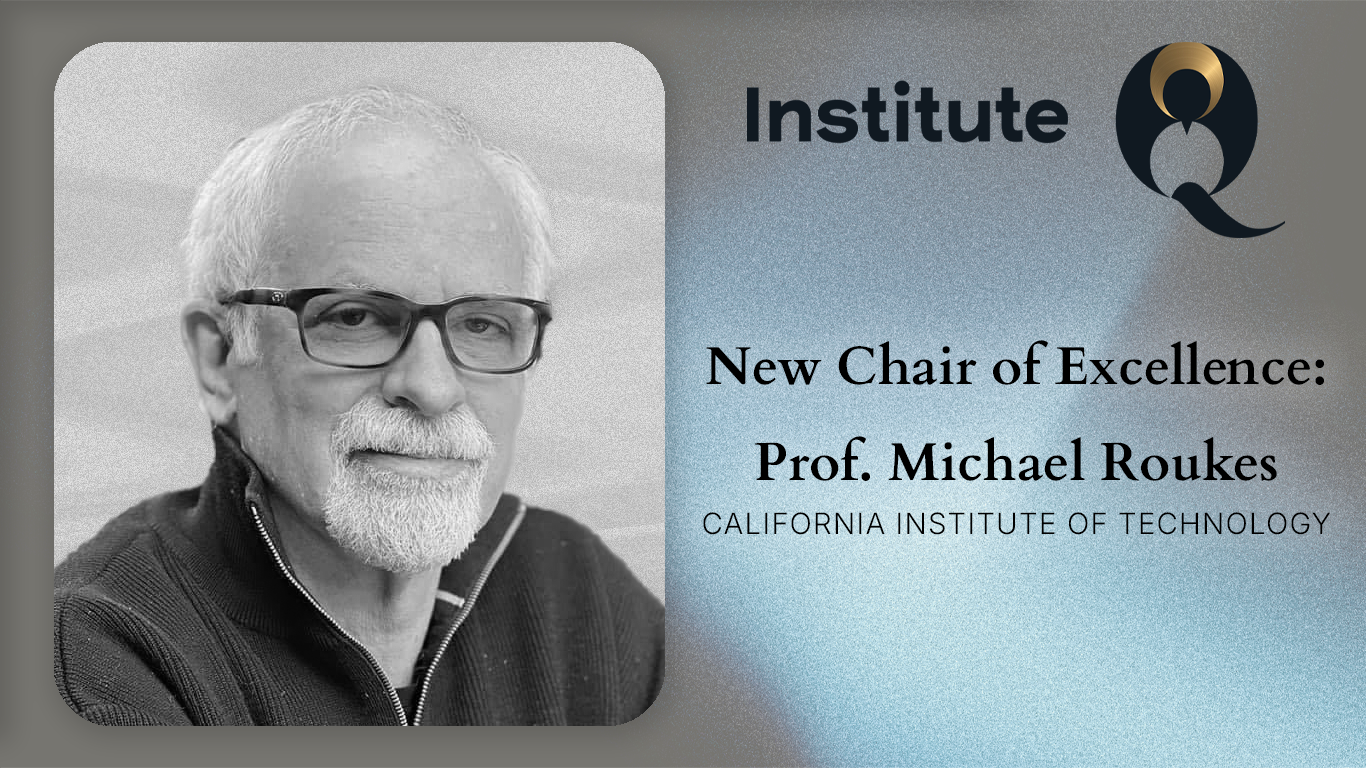
Professor Michael Roukes has been selected as an InstituteQ Chair of Excellence, hosted at Aalto University.
Roukes is the Frank J. Roshek Professor of Physics, Applied Physics, and Bioengineering at the California Institute of Technology.
His research activities are currently focused on developing advanced nanodevices, engineering them into complex systems, and using them to enable fundamental problems in physics, neuroscience and proteomics. A continuing thread in theoretical and experimental investigations focuses on fundamental properties of nanomechanical systems.
Most recently, Michael has co-Founded NanoSCAn Systems, Inc. with the aim of commercializing Nanosystems-enabled Single-Cell Analysis instrumentation for deep profiling of the single-cell proteome with single-molecule resolution and high throughput.
We sat down with Roukes to discuss his plans for his time as InstituteQ Chair of Excellence. This interview has been edited for length and clarity from its original version.
You have expressed your interest during your research stay as Chair of Excellence in exploring the field of quantum calorimetry. How does this tie into your group’s research up until now?
My research has long spanned both fundamental physics and applied science. One of my major efforts has been developing nanoscale devices for single-molecule analysis, particularly of proteins. The challenge is to measure individual proteins at high throughput, including rare proteins that may play crucial roles in cellular processes. Addressing this requires highly sensitive, precision devices, drawing on some of the same foundational knowledge used in quantum computing.
These seemingly different applications share important challenges in quantum thermodynamics. I’m particularly interested in understanding how heat is transferred and how systems thermalize at the nanoscale, in both classical and quantum regimes. Thermalization is fundamental to computation because a system must dissipate energy and settle back into a usable state before the next operation. Understanding these processes can help us push the boundaries of both quantum technologies and nanoscale measurement.
You seem to have a long history in the Finnish quantum research scene – did I understand correctly you were in Finland as a graduate student?
I was a graduate student in the ultra-low-temperature physics group at Cornell, but my connection to Finland goes back to around 1982. My advisor, Bob Richardson, was a close friend of researchers in Helsinki, and Finnish scientists visited Cornell while I was a student. That was when I first met Jukka Pekola, and we’ve known each other ever since.
Our research interests have long overlapped, particularly around quantum thermodynamics and the physics of low-temperature systems. We began discussing a possible collaboration about five years ago, and those conversations eventually led to my appointment as Chair of Excellence. It’s rewarding to return to these questions with someone who shares my appreciation for the experimental craft and deep understanding needed to build complex apparatus for exploring new physics.
How do you see the role of collaborative organizations like InstituteQ in developing advancements in the field of quantum science and technology?
I think they are essential. Many of the frontiers in quantum science are highly interdisciplinary, requiring different technologies, expertise and perspectives. When I reshaped my research group at Caltech to bring together people from fields ranging from mathematics to cell biology, I discovered how much everyone could learn from one another. I saw my role not simply as the person generating ideas, but as a facilitator helping people work together.
Both formal and informal collaborative networks are key to making progress. Science is an international community, and advances emerge when people can bring their complementary expertise together around shared challenges. Organizations such as InstituteQ can help create the environment in which these collaborations flourish, across research, education and innovation.
In fact, you also have history with another one of InstituteQ’s recently announced Chairs of Excellence. What is your history with Andrew Cleland?
Andrew Cleland was my first postdoctoral researcher when I moved to Caltech. I had begun working on nanomechanical systems at Bell Labs, but had not yet established the measurement instrumentation needed to explore them fully. When I moved to Caltech, Andrew helped me build the laboratory and carry out our first measurements on nanomechanical systems. Together, we helped establish a field that has since grown into a major international research area.
Our collaboration is part of a much longer history of researchers working around shared challenges in low-temperature physics and quantum measurement. Over more than four decades, many of us have remained connected through these scientific questions. Andrew is particularly interesting because his work has bridged both fields, and it’s gratifying to see how these long-standing connections continue to shape the quantum research landscape today.
Quantum science and technology have been receiving a lot of attention in the media lately. What are some developments of the field you are paying close attention to?
One of the most satisfying developments over my career has been the convergence of quantum optics and condensed-matter physics. When I started at Caltech in 1992, these were largely separate communities. Quantum optics could explore individual atoms and their interactions with single quanta of light, while achieving comparable control over quantum phenomena in solid-state systems seemed like a distant prospect.
Nanoscale systems have helped bridge that divide. We can now engineer and control solid-state systems in ways that once seemed far beyond reach. New materials, including van der Waals materials, offer further possibilities: by assembling atomic layers into carefully designed structures, researchers can create systems with properties that differ from those of the bulk materials.
The possibilities are exciting, but there are still many open questions about what quantum technologies will ultimately deliver. Much of this remains a matter of research and demanding engineering, and it is far from clear exactly where we will be in ten years. That uncertainty is part of the scientific process.
You mention new collaborations, spanning from groups like Jukka Pekola and Mika Sillanpää here at Aalto, as well as many others in the US. How do you see the quantum research environments when comparing Finland and the US? How are they evolving, and where is there room for synergy versus competition?
I agree that Finland punches above its weight. It has built an impressive foundation in low-temperature physics and quantum measurement over decades, and that expertise has helped create the conditions for internationally significant research and technological innovation.
The United States has a much larger research infrastructure and greater financial resources, but having more money does not automatically bring the right people together. Developing a strong research environment also requires a coherent vision: understanding where the strengths lie, which people can build on them, and how to create the critical mass needed for progress. That can be difficult in a large system.
Finland has done this particularly well in low-temperature physics and quantum measurement. My Chair of Excellence provides an opportunity to build on that foundation by connecting Finnish expertise with complementary capabilities and researchers in the United States. Especially in interdisciplinary fields, these international connections can help create new opportunities that neither environment would develop as effectively in isolation.
As an experimentalist dealing in quantum devices and hardware, what are some of the biggest “nuts to crack” of the field in your view?
One of the central challenges is learning to engineer solid-state systems in which quantum effects can be controlled and observed with the precision achieved in quantum optics. When I began working at Caltech, that level of control in condensed-matter systems seemed like a distant goal. Seeing how far the field has progressed since then has been tremendously satisfying.
Achieving this requires bringing together expertise in quantum measurement, condensed-matter physics, materials science and nanofabrication. We need to build systems that are sufficiently small and clean to exhibit robust quantum effects, while understanding the physics that governs their behaviour. This is also where low-temperature physics remains important: at these temperatures, the behaviour of matter reveals phenomena that can be difficult to access otherwise.
Another fundamental challenge is understanding thermalization and heat transfer at the nanoscale. Computation involves repeated changes in the state of a system, followed by the dissipation of energy before the next operation. How quickly that system can return to a usable state helps determine the speed limits of computation. Understanding these processes in both classical and quantum regimes is an important frontier.
If you could pick one key accomplishment you hope to achieve during your Chair of Excellence term, what would that be and why?
I would like to push the frontiers of our understanding of how heat is transferred inside nanoscale devices, in both the classical and quantum regimes. This is a longstanding interest of mine, dating back to my graduate research, and it connects naturally with Jukka Pekola’s pioneering and inspiring work in quantum thermodynamics.
What makes the collaboration particularly exciting is its potential to bring together complementary expertise and approaches. By combining our experience with that of researchers working in quantum measurement, nanomechanical systems and condensed-matter physics, we can explore fundamental questions that also have implications for future technologies. I hope we can advance that understanding while creating new connections between the Finnish and US research communities.